


James Allen WARD
vC
N.Z. VC No.
17
Global No. 1,192


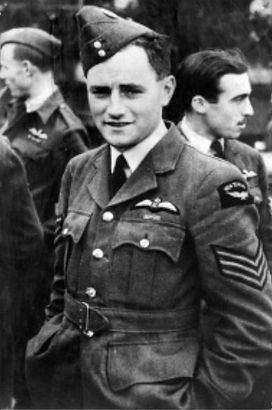

Born:
Died:
Military Service:
Enlisted:
Disharged:
Units:
VC Action
VC Rank:
Final Rank:
14 Jun 1919, Wanganui, N.Z.
15 Sep 1941, over Hamburg, Germany
Royal New Zealand Air Force 1940-41
(Europe)
1939
Killed In Action
No. 75 Squadron
7 Jul 1941, Munster, Germany
Sergeant
Sergeant Pilot

MINI BIO
James attended Wanganui Technical College and then trained as a teacher at the Wellington College of Education in 1938. He taught until enlisting in the RNZAF 2 Jul 40.
After training he was posted to Scotland flying Wellington bombers.
7 Jul 41 he was co-pilot on a Vickers Wellington which was attacked after a successful bombing raid over Munster, Germany. One of the engines caught fire and James climbed out on to the wing to put the fire out. After smothering the fire they were able to make an
emergency landing back in England.
The recommendation for a VC was a matter of discussion at the time.
Senior RAF officers questioned whether a VC was appropriate since his actions had some aspect of self-preservation.
James Ward was killed in action on 15 Sep 1941, when his Wellington bomber was hit by flak over Hamburg, caught fire and crashed.
The Victoria Cross was presented to James' brother by the Governor General of NZ at Government House, Wellington on 16 October 1942. .
LONDON GAZETTE
No. 35238
5 August 1941
On the night of 7 July 1941, Sergeant Ward was second pilot of a Wellington bomber returning from an attack on Munster. While flying over the Zuider Zee at 13,000 feet his aircraft was attacked from beneath by a German Bf 110, which secured hits with cannon-shell and incendiary bullets. The rear gunner was wounded in the foot but delivered a burst of fire sending the enemy fighter down, apparently out of control. Fire then broke out in the Wellington's near-starboard engine and, fed by petrol from a split pipe, quickly gained an alarming hold and threatened to spread to the entire wing. The crew forced a hole in the fuselage and made strenuous efforts to reduce the fire with extinguishers, and even coffee from their flasks, without success. They were then warned to be ready to abandon the aircraft. As a last resort Sergeant Ward volunteered to make an attempt to smother the fire with an engine cover which happened to be in use as a cushion. At first he proposed discarding his parachute to reduce wind resistance, but was finally persuaded to take it. A rope from the aircraft dingy was tied to him, though this was of little help and might have become a danger had he been blown off the aircraft.
With the help of his navigator he then climbed through the narrow astrodome and put on his parachute. The bomber was flying at a reduced speed but the wind pressure must have been sufficient to render the operation one of extreme difficulty. Breaking the fabric to make hand and foot holds where necessary and also taking advantage of existing holes in the fabric, Sergeant Ward succeeded in descending three feet to the wing and proceeding another three feet to a position behind the engine, despite the slipstream from the airscrew which nearly blew him off the wing. Lying in this precarious position he smothered the fire in the wing fabric and tried to push the engine cover into the hole in the wing and on the leaking pipe from which the fire came. As soon as he had removed his hand, however, a terrific wind blew the cover out and when he tried again it was lost. Tired as he was, he was able, with the navigator's assistance, to make a successful but perilous journey back into the aircraft. There was now no danger of fire spreading from the petrol pipe as there was no fabric left near it and in due course it burned itself out. When the aircraft was nearly home, some petrol which had collected in the wing blazed up furiously but died down quite suddenly. A safe landing was made despite the damage sustained to the aircraft. The flight home had been made possible by the gallantry of Sergeant Ward in extinguishing the fire on the wing in circumstances of the greatest difficulty and at the risk of his life.


