Richard Charles TRAVIS
VC DCM MM
N.Z. VC No.
7
Global No. 1,021


Born:
Died:
Military Service:
Enlisted:
Disharged:
Units:
VC Action
VC Rank:
Final Rank:
Other:
6 Apr 1884, Opotiki, N.Z.
25 Jul 1918, Rossignol Wood, France
New Zealand Expeditionary Force 1914-18
(Gallipoli, Western Front)
20 Aug 14
Killed In Action
Otago Mounted Rifles Regiment (1914-16)
2nd Battalion, Otago Infantry Regiment (1916-18 VC)
24 Jul 1918, Rossignol Wood, France
Sergeant
Sergeant
Distinguished Conduct Medal (DCM)
Military Medal (MM)
Belgian Croix De Guerre

MINI BIO
Born “Dickson Cornelius Savage”, he attended local schools until starting work on the family farm. A capable shepherd, drover and farmhand, he excelled at horse-breaking.
After quarrelling with his father he went to the Gisborne district in 1905, where he continued work as a farmhand, driver and horse breaker. He cut off all ties to his family and changed his name to Richard Charles Travis.
After enlisting, he sailed with the main body of the NZEF, arriving Egypt in Dec 14.
Impatient to see action, he unofficially accompanied his regiment to Gallipoli, May 1915.
Returned to Egypt, he received 14 days' detention. He did return to Gallipoli, moving with impunity between the New Zealand and Turkish trenches on scouting patrols.
A knee injury forced a transfer to 2nd Battalion, Otago Infantry Regiment. Arriving in France Apr 16, he began nocturnal scouting activities in no man's land, mapping the German defences for the first New Zealand trench raids.
Travis displayed 'conspicuous gallantry' on 15 Sep 1916, eliminating several snipers for which he was awarded the DCM. He was promoted Sergeant and given command of the battalion's new sniper and observation section. His casual attitude towards rank and
dress regulations contrasted with the careful planning, daring and resourcefulness of his anti-sniper work and lone patrols. Richard was awarded the Belgian Croix de Guerre on15 Feb 18, and Military Medal May 18.
24 Jul 18 Richard destroyed an impassable wire block in front of the enemy lines prior an attack. He then captured two enemy machine-guns. He was killed by shellfire the following day, and was buried at Couin on 26 July. The entire New Zealand Division
mourned the loss of the 'King of No Man's Land'. For his 'most conspicuous bravery and devotion to duty' on 24 July, Travis was posthumously awarded the Victoria Cross..
LONDON GAZETTE
No. 30922
24 September 1918
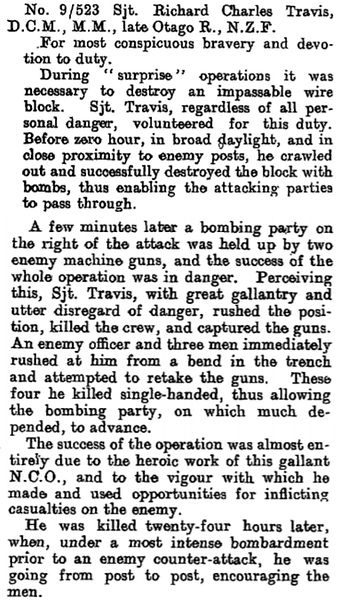
For most conspicuous bravery and devotion to duty. During 'surprise' operations it was necessary to destroy an impassable wire block. Serjt. Travis, regardless of personal danger, volunteered for this duty. Before zero hour, in broad daylight and in close proximity to enemy posts he crawled out and successfully destroyed the block with bombs, thus enabling the attacking parties to pass through. A few minutes later a bombing party on the right of the attack was held up by two enemy machine guns, and the success of the whole operation was in danger. Perceiving this Serjt. Travis with great gallantry and utter disregard of danger, rushed the position, killed the crews and captured the guns. An enemy officer and three men immediately rushed at him from a bend in the trench and attempted to retake the guns. These four he killed single handed, thus allowing the bombing party on which much depended to advance. The success of the operation was almost entirely due to the heroic work of this gallant N.C.O. and the vigour with which he made and used opportunities for inflicting casualties on the enemy. He was killed 24 hours later when, in a most intense bombardment prior to an enemy counter-attack, he was going from post to post encouraging the men.